


PJM Reopens the Queue — And Natural Gas Is Back in the Driver’s Seat

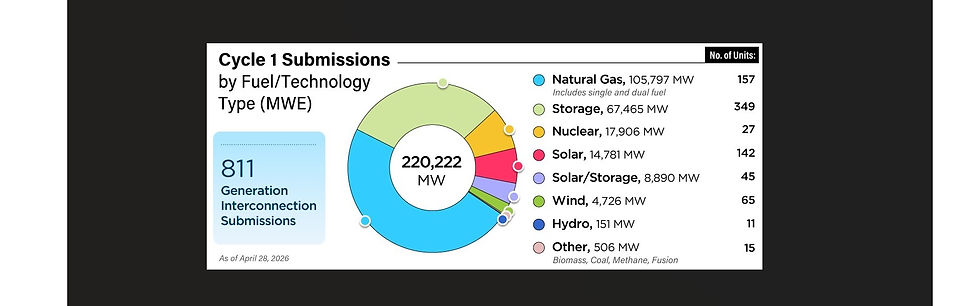
After years of delays and reform, the PJM Interconnection has officially reopened its interconnection queue—and the response has been immediate and massive.
Queue Cycle #1 attracted 800+ projects totaling ~220 GW of capacity.
What stands out: natural gas is the single largest fuel type in the queue, even as renewables dominate project count.
That headline deserves a second look.
Historically, only a small fraction of interconnection requests actually reach commercial operation—often less than 20–25%. Attrition is driven by permitting hurdles, rising capital costs, transmission constraints, and shifting market economics.
So what does this mean for PJM’s supply/demand balance?
1) Reliability vs. Reality - Gas projects in the queue signal a market response to tightening reserve margins and dispatchable capacity needs. But if most never get built, the perceived reliability backstop may not materialize.
2) Renewable Saturation Meets Grid Constraints - Solar and storage dominate project count, but face interconnection bottlenecks and curtailment risk. Without sufficient transmission upgrades, many projects stall—delaying incremental supply.
3) Tightening Capacity Outlook - If completion rates remain low across both gas and renewables, PJM could face a structurally tighter capacity market. This supports higher capacity prices and increased volatility—especially during peak demand periods.
4) Gas as the “Insurance Policy” - Even if only a subset of gas projects move forward, they may disproportionately shape forward supply expectations. Gas remains the most financeable, dispatchable hedge against intermittency.
Bottom line:
The queue reopening is not a supply surge—it’s an option set. Until projects clear the gauntlet of economics and interconnection, the real signal may be future scarcity, not abundance.
In a system balancing decarbonization with reliability, execution—not intention—will define PJM’s next decade.
Sources:

Comments